AI assistants like ChatGPT can now find products and check out for shoppers. Here is how agentic commerce works and how to make your Magento or Hyvä store ready: honestly, and step by step.
The May 2026 Mage-OS community discussion on AI in Magento did not end with a roadmap. It ended with three camps, AI in core as a first-party Magento_AiAssist module, AI as a pluggable extension layer where Panth_AiAssist and others compete, and AI as a developer-only tool that never touches the customer runtime. Each camp is internally coherent and incompatible with the other two. This editorial walks the arguments, names the trade-offs (governance versus innovation speed, OpenAI dependency versus self-hosted Llama 3 and Mistral), explains what Adobe Sensei means for the Open Source side of the split, and ends with three concrete steps Open Source merchants on Magento 2.4.4-2.4.9 can take this week regardless of which camp wins.
Magento developers waste hours re-grepping the same documentation, Adobe DevDocs, Hyvä, Mage-OS, internal CLAUDE.md notes, every time a new team member ramps up or a familiar one forgets which DI argument was renamed in 2.4.7. A real retrieval-augmented generation pipeline collapses that into a single REST endpoint that takes a question and returns a cited, paragraph-length answer in under a second. This article walks through the working pipeline shipped on kishansavaliya.com: crawler, chunker, embeddings, pgvector store, Magento controller, and the ragas evaluation harness that keeps it honest.
Adobe Sensei Product Recommendations ships only with Adobe Commerce: Magento Open Source merchants do not get it. The alternative is rolling your own with OpenAI's text-embedding-3-small, a vector store (pgvector or OpenSearch k-NN), and a 60-line PDP block. This is the honest comparison: Sensei's managed recommendations versus a custom embedding stack that costs $0.02 per 1,000 products to embed, $5/month for a Redis cache, and gives you full ranking transparency. Includes the cold-start playbook (category-centroid embeddings until behavioural signals arrive), the pgvector schema, the OpenAI batch call, and the break-even math: at 100,000 monthly sessions, Sensei needs 0.4% incremental revenue to pay for itself; the custom stack needs a much smaller lift.
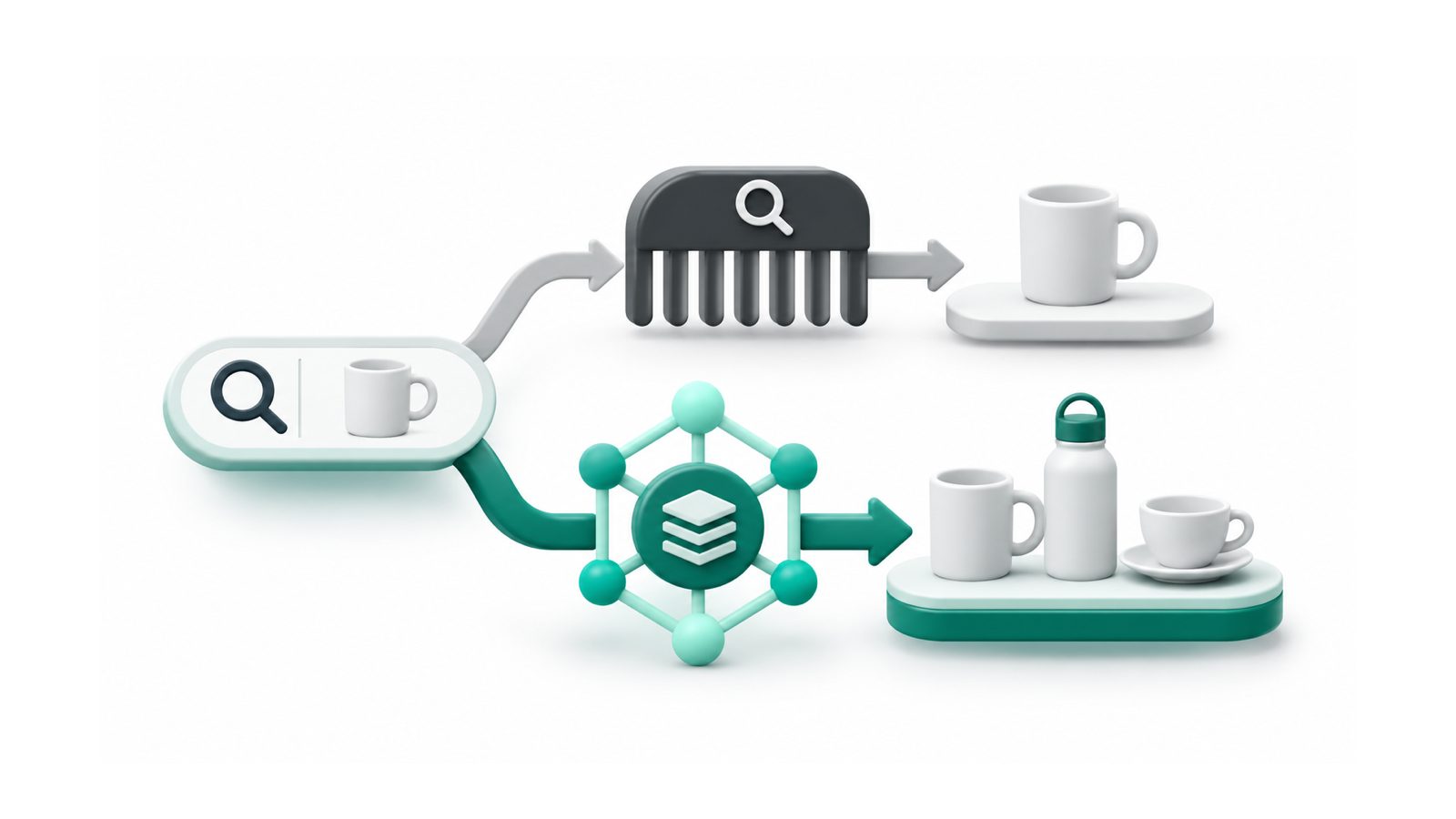
Three search stacks were wired into the same Magento 2.4.9 + Hyvä storefront over a 50k-SKU catalog, and the results were not what the vendor decks promise. OpenSearch k-NN with OpenAI text-embedding-3-small ran at ~$0.02 per million tokens and held query latency under 120 ms; Algolia shipped in a weekend but billed $0.50 per thousand searches at scale; Coveo nailed precision but cost north of $20k a year. The article walks through each stack with real config, the embedding-model trade-off, and the 60/40 hybrid score blend that beats all three on the queries customers actually type.
A bulk workflow for rewriting Magento 2.4.9 + Hyvä product descriptions with the Claude API, with a human review step and prompt caching to keep API spend low. This is the actual CLI command, the brand-voice prompt template, the duplicate-content guard that compares each new description against every prior one in the same category, and the cost math against rule-based template generators. Built for stores with 1,000-50,000 SKUs where hand-written descriptions are economically impossible and template engines produce thin, doorway-flavored content.
ChatGPT + Magento 2 is the most-asked AI question of 2026, and the most pattern-light. Here are the four integrations we have shipped in production, with the actual OpenAI API code, the per-call cost math, and the failure modes we learned the hard way.