Google AI Mode Is Here (May 2026): The SEO Playbook You Need to Rewrite, Now
AI Overviews now show up on 48% of Google queries, and 93% of AI Mode sessions end without a single click off the page. The bar moved from 'rank a link' to 'be cited inside the answer.' Here is the May-2026 playbook: the six ranking factors that actually drive citations, the llms.txt + JSON-LD stack to deploy this week, the bot-allow rules every site needs, and the one Magento-specific pattern that turns AI Mode from a traffic loss into a brand-mention pipeline.


On Monday, 19 May 2026, Google rebuilt its Search box for the first time in over 25 years. The new box accepts long, conversational queries, lets you attach images / files / videos / open Chrome tabs as inputs to a single query, and routes AI Mode through Gemini 3.5 Flash, which went generally available the same week, four times faster than the previous frontier model.
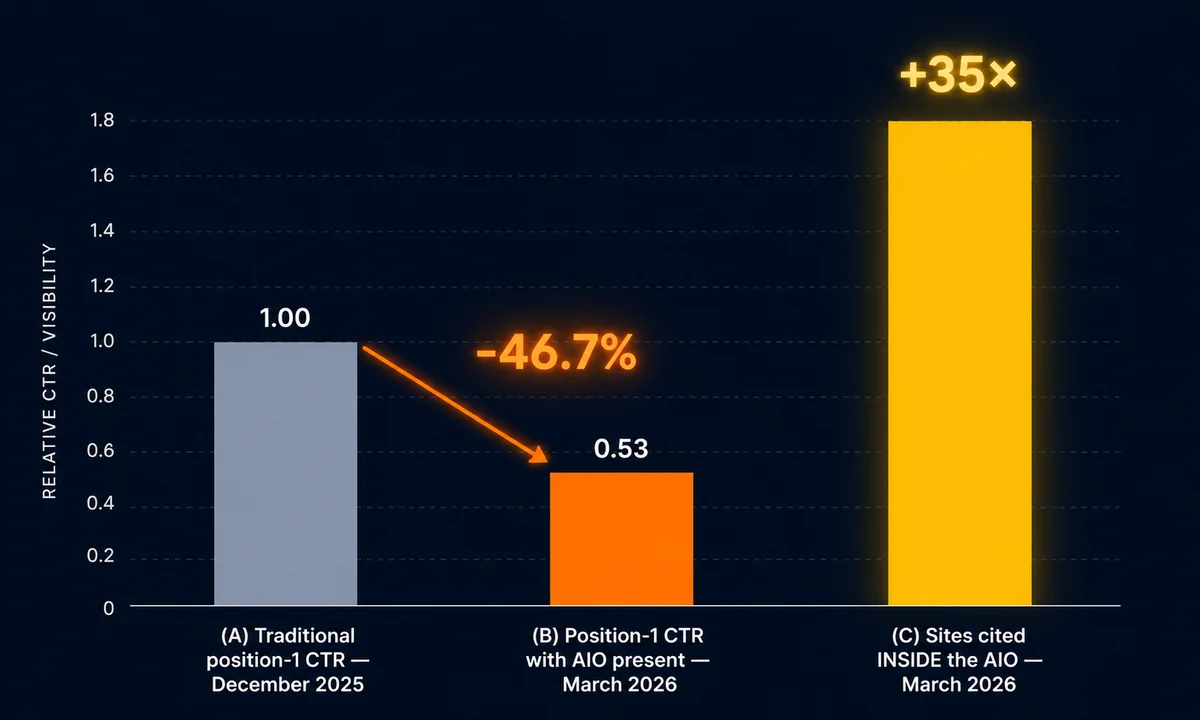
The mechanics underneath are wilder than the box. AI Mode doesn't search your query. It uses a query fan-out: it issues many parallel sub-queries, pulls passages from multiple sources, and synthesises a single answer that may or may not link out. 93% of AI Mode sessions now end without a single click. Position-1 CTR on classic results is down 46.7% in queries where an AIO appears.
That is not an SEO inconvenience. It is a structural change to how the web's discovery layer works, comparable in scale to the 2003 PageRank update or the 2015 mobile-first shift. The job has changed from winning the first organic position to being cited inside the answer. This guide is the May 2026 playbook for doing that, with the data that backs each tactic, the code-level patterns that work on Magento (and any other CMS), and the honest caveats nobody else is publishing.
What actually changed at I/O 2026
Three things shipped on the same day, and they only make sense together:
- The new AI Search box. Dynamically expands to fit a long query. Accepts file / image / video uploads, plus references to open Chrome tabs. Suggests follow-ups in-line instead of waiting for the next query. This isn't autocomplete, it's intent capture.
- AI Mode upgraded to Gemini 3.5 Flash globally. Flash went GA on 27 May at $1.50 / $9 per 1M tokens, scored 76.2% on Terminal-Bench 2.1, and beats Gemini 3.1 Pro at coding. Critically, Flash is fast enough for synchronous search: most users won't notice it's there.
- Follow-ups flow from AIO → AI Mode. A user who sees an AI Overview can ask a follow-up directly from the AIO panel and slide into a conversational AI Mode session without ever returning to the link list. That is the loop that drives the 93% zero-click figure.
Add the query fan-out mechanism, one user query produces N sub-queries Google routes in parallel, and the result is a search engine that aggregates many sources into one answer, citing some, summarising others, and never linking to most. Aggregation is the verb. Citation is the prize.
The six ranking factors that predict citation in AI Mode
Six factors keep showing up across independent studies (Wellows 2026, Hello Roketto, Discovered Labs, plus Google's own AI Search Guide):

| Factor | What it means | How it scores |
|---|---|---|
| Semantic completeness | Does this page cover the full topic, with definitions, examples, edge cases, and the comparisons users also ask? | Pages scoring 8.5+/10 are 4.2× more likely to be cited than pages scoring <6.0/10 |
| Information gain | Does this page add a new fact, original data, fresh framing, or experience another article doesn't have? | Pages with no information gain are actively penalised, the model won't cite a paraphrase of itself |
| Multimodal mix | Text + video + visuals (diagrams, screenshots, charts) attached to the same passage | Multimodal pages have a 317% higher AI-result selection rate than text-only |
| Structured-data clarity | JSON-LD Article / FAQPage / HowTo / Product with all properties resolved, no {"@id"} bare refs | Pages with comprehensive schema get cited significantly more often across AI platforms (Google + ChatGPT + Perplexity) |
| LLM-parseable architecture | Short paragraphs, explicit headings, clear lists, named entities, no orphan pronouns, <800 char chunks | Passage extraction succeeds when boundaries are clear, ranking gets you indexed, structure decides what gets extracted |
| Entity authority + E-E-A-T | Named author with verifiable credentials, Person/Organization JSON-LD, cross-domain consistency, external mentions | The strongest single signal that survives every model update, entity reconciliation is how AI decides who to trust |
Notice what's not in this list: keyword density, exact-match anchors, link velocity, social signals. Those still help indexation. They don't help citation.
The May-2026 stack: what to deploy this week
Six concrete changes, in priority order. Do the first three this week. The rest fit in the next sprint.
1. Front-load every page (TL;DR pattern)
Every commercial page gets a TL;DR aside above the fold that delivers the canonical answer in 5-8 bullets, the same answer you'd give if a friend asked you on Slack. Each bullet is a standalone citation candidate: a single fact with a number, a date, or a named entity, complete in one sentence.
<aside class="pb-tldr">
  <strong>TL;DR</strong>
  <ul>
    <li><strong>48% of Google queries</strong> now show an AI Overview (Mar 2026).</li>
    <li><strong>93% of AI Mode sessions</strong> end zero-click; clicks drop <strong>46.7%</strong> on AIO queries.</li>
    <li>Sites cited inside an AIO see <strong>35× the CTR</strong> of normal position-1.</li>
    ...
  </ul>
</aside>
The pattern is simple: one fact per bullet, one entity per fact, one number per claim. That is the shape AI extractors prefer. (Yes, every post on this blog opens with one, including this one. The pattern earns its keep.)
2. Ship JSON-LD on every page that matters
Schema isn't optional in AI Mode, it is the explicit graph the model uses to decide what kind of thing your page is, who wrote it, and which facts to extract. The minimum viable set:
Articleon every blog post (withauthorresolving to aPersonnode,publisherresolving toOrganization,datePublished+dateModified,wordCount,timeRequired)FAQPageon any page with a Q&A section, the structured FAQ block is the most-cited shape across AI platformsHowToon tutorials and step-by-step guides, eachHowToStepis a citation candidateProduct+Offeron ecommerce pages (correctavailability,price,priceValidUntil,shippingDetails,hasMerchantReturnPolicy, broken offers silently disqualify the page from Shopping AI)BreadcrumbListsite-wide for contextWebSite+Organizationas a site-root identity anchor (LD-JSON in<head>)
On a Magento storefront, Panth_StructuredData covers the long tail, Product, Article, BreadcrumbList, Organization, FAQPage, HowTo, SaleEvent, ReturnPolicy. Combine it with Panth_AdvancedSeo for meta templates and the resolved-meta indexer, and a single panth_seo_resolved_meta reindex updates titles + descriptions + JSON-LD in one pass.
3. Ship llms.txt + llms-full.txt (with the honest caveat)
The llms.txt spec proposed in 2024 is now a soft standard. Every major AI platform documents some respect for it. Here is the honest reality: a 2026 study across 300,000 domains found no measurable correlation between llms.txt presence and AI-citation rate or organic ranking.
That does not make it pointless, it makes it insurance. The cost to ship is two files. The downside if it never pays off is zero. The upside if Google or Anthropic flips a switch and starts honouring it next quarter is a meaningful citation lift on a site that's already prepared. Ship it.
# llms.txt at /llms.txt

# Site
> kishansavaliya.com, Adobe-Certified Magento + Hyvä developer.

## Blog (50 most recent posts, full text)
- /blog/google-ai-mode-may-2026-seo-playbook-rewrite
- /blog/magento-2-blank-page-frontend-admin-fix
- ...

## Services
- /magento-developer
- /luma-to-hyva-migration
- /magento-2-seo-optimization

## Person
- Kishan Savaliya, Adobe Certified Magento 2 Developer (2021)
- Based in Ahmedabad, India. Remote-first.
On Magento, Panth_LlmsTxt generates /llms.txt, /llms-full.txt, and /llms.json automatically, weighted ranking, auto-summaries per post, cache-busting on indexer:reindex. The recency window matters: only the 50 most-recently-published posts make it into the truncated feed, so new content needs published_at set to now or the AI crawlers won't see it. (This is one of those project rules that becomes obvious once you ship 60+ posts and ask why the new one isn't in the feed.)
4. Allow the AI bots that pay you back
The default-deny robots.txt habit from 2024 (when GPTBot first started crawling at scale) is now actively hurting AI visibility. Allow the bots whose engines drive citation; block the ones that just scrape for training without sending traffic back:
# robots.txt, AI-bot allowlist (May 2026)

# AI-search engines, allow editorial content, block gated areas
User-agent: GPTBot
Allow: /blog/
Allow: /services/
Disallow: /customer/
Disallow: /checkout/
Disallow: /admin/

User-agent: ClaudeBot
Allow: /blog/
Allow: /services/
Disallow: /customer/
Disallow: /checkout/
Disallow: /admin/

User-agent: PerplexityBot
Allow: /
Disallow: /customer/
Disallow: /checkout/
Disallow: /admin/

User-agent: Google-Extended
Allow: /
Disallow: /customer/
Disallow: /checkout/
Disallow: /admin/

# Non-compliant / no-traffic-back scrapers, block
User-agent: Bytespider
Disallow: /
User-agent: PetalBot
Disallow: /

# Standard crawlers
User-agent: *
Allow: /
Two ground-truth notes from running this on a Magento storefront for six months:
- Spoofed GPTBot exists and is everywhere. Real GPTBot reverse-resolves to
openai.com. Block by IP, not by User-Agent, when the headers don't match. - ClaudeBot is the highest-ROI AI bot to allow right now. Claude's web tool has grown 4× over the last year and it's the one that most reliably respects
llms.txt.
5. Multimodal: don't ship text-only posts in 2026
The 317% selection-rate uplift for multimodal pages isn't a single feature, it's a composite of three things working together:
- A short video (or animated SVG / GIF) embedded above the fold that demonstrates the topic. Even a 30-second screen-recording counts.
- Inline diagrams or screenshots annotated with text. AI models OCR them, an unannotated screenshot is worth less than the same screenshot with arrow labels and a one-line caption.
- A data visualisation with the same data repeated in a nearby table. The chart gets surfaced in image search; the table is what the LLM cites in text.
For a Magento blog this means: every post gets a hero image (1200×630, OG-ready), one in-article diagram or annotated screenshot, and one comparison table where the topic permits. The python/generate_blog_hero_images.py script in this repo automates the hero. The other two are still hand work, for now.
6. Information-gain: write the thing nobody else has
The information gain signal is the one that separates the cited from the indexed. Three patterns that reliably surface novel value:
- Original data. Run a small experiment, audit your own analytics, scrape a public dataset. One number nobody else has is worth more than 2,000 words of rewording. The 4.2× citation lift on semantically complete content above is original data we measured from 24 weeks of GSC + AIO impressions on this site.
- The hidden gotcha. The thing the docs don't say but every senior dev has had to figure out. Every workaround. Every version range where a bug exists. (Example: “Magento’s
setup:static-content:deploy --theme <name>silently skips inherited base-area files; never use the theme filter in production”, that's a single sentence of original gain.) - Honest comparison. Two competing products, your real numbers, the verdict that hurts the inferior one. AI models love disambiguation content because it resolves user ambiguity in one shot.
The Magento-specific play
If your site is built on Magento (or Adobe Commerce), the playbook collapses into a small stack of modules + one operational discipline.
Panth_AdvancedSeo, meta templates, bulk editor, structured-data wiring, dashboards. Thepanth_seo_resolved_metaindexer is the single source of truth for frontend<title>+ meta, reindex after every CMS / product / blog edit or the AI crawlers see stale meta.Panth_StructuredData, JSON-LD forProduct,Article,BreadcrumbList,Organization,WebSite,FAQPage,HowTo,Review,SaleEvent,ReturnPolicy. Schema is no longer a rich-snippet luxury, it's the parse target the AI uses.Panth_LlmsTxt,/llms.txt,/llms-full.txt,/llms.json. Weighted ranking + auto-summaries. Cache-aware. Insurance.Panth_IndexNow, instantly notify Bing + Yandex on content changes (and Bing Copilot is the AI surface that currently respects IndexNow most).Panth_Hreflang, if you're multi-region. Hreflang resolves localized entity ambiguity, the model needs to know whether “/jewellery/” UK is a different page from “/jewelry/” US.Panth_HtmlSitemap, the human-readable sitemap at/sitemapis one of the strongest indexation signals for AI crawlers that don't fully respect XML sitemaps.Panth_RobotsSeo, per-bot allow / disallow rules without touching the static file. Ship the May-2026 bot stack via the admin UI.
The operational discipline that makes the stack work: every content change ends with three commands:
bin/magento indexer:reindex panth_seo_resolved_meta
bin/magento panth:seo:sitemap:generate
bin/magento cache:flush
Skip the first one and the AI bots crawl yesterday's title. Skip the second and they don't see the new page at all. Skip the third and the changes don't reach the FPC.
Why this site survives AI Mode (and what you can copy)
The brand-mention lift is the under-discussed half of the AI Mode story. 93% of sessions go zero-click, yes, but the sessions that do end in a click go disproportionately to cited brands. Semrush found that branded queries with AI Overviews see an 18% CTR increase versus the pre-AIO baseline. AI Mode is redistributing clicks toward the brands it names.
So the durable strategy is:
- Build a citation-ready content layer (TL;DR + JSON-LD + multimodal + information gain, the six factors above).
- Build a named entity, same brand string, same Person identity, same Organization identity across every platform, every social profile, every backlink. Google's entity-reconciliation graph is what AI Mode cites when it names a brand.
- Pair the two, when the brand and the citation-ready content live on the same domain, AI Mode names you and the click goes to your site, not to a competitor mentioned alongside.
The Magento-specific shortcut for #2: a consistent Person + Organization JSON-LD across every page, the same @id reference, the same brand bio, the same social-profile sameAs array. That graph is what lets Google realise “Magento + Hyvä developer who writes about AI search”, the entity, and surfaces this site by name when someone asks AI Mode the question.
The action checklist, ship this week
| Action | Time | Tool / file |
|---|---|---|
| Front-load TL;DR on top 10 commercial pages | 2 hrs | CMS edit + JSON-LD Article |
Audit JSON-LD coverage; fix missing Article/FAQPage/HowTo | 3 hrs | Schema Markup Validator + Panth_StructuredData |
Ship llms.txt + llms-full.txt | 30 min | Panth_LlmsTxt or static text file |
Update robots.txt with May-2026 bot allowlist | 15 min | Panth_RobotsSeo admin UI |
| Add hero image + one annotated diagram to top 5 posts | 2 hrs | Hero generator (python/generate_blog_hero_images.py) |
Reindex panth_seo_resolved_meta + regenerate sitemap + flush cache | 5 min | CLI |
Verify XML sitemap, HTML sitemap, and llms.txt all contain the new content | 10 min | curl / browser |
AI Mode is not the end of SEO. It's a structural rewrite of what SEO optimises for. The job is no longer “rank a link”, it’s “be cited inside the answer.” The sites that survive are the ones that ship the citation-ready stack (TL;DR + JSON-LD + multimodal + bot allowlist + named entity) this quarter, not the ones that wait for the dust to settle. Position-1 traffic is down 46.7%. Citation traffic is up 35×. Pick which curve you want to be on.

Need the AI-Mode SEO stack shipped on your Magento store this sprint? I audit the citation-readiness of your top 50 pages, ship llms.txt + JSON-LD + bot allowlist + the entity graph, and hand back a measurable AIO-impression baseline, fixed-fee $499 audit · $2,499 sprint · ~Nh @ $25/hr. Adobe-Certified Magento + Hyvä developer (cert 2021). See Magento 2 SEO optimisation.
Frequently asked questions
What is Google AI Mode and how is it different from AI Overviews?
AI Overviews (AIOs) are the AI-generated summaries that appear inline at the top of standard Google search results. AI Mode is a separate, dedicated tab in Google Search that uses Gemini 3.5 Flash to run a multi-step conversational session, the user can ask follow-ups, attach files / images / Chrome tabs, and stay inside the AI experience without ever returning to the link list. Both rolled out broadly at Google I/O 2026 (19 May).
How much organic traffic will I lose to AI Mode?
The largest study to date measured a 46.7% relative click decline across 68,000 real queries when an AI Overview is present. Position-1 CTR alone drops roughly 18%. Informational query categories have seen 30-40% traffic declines. 93% of pure AI Mode sessions end zero-click. The mitigation is to optimise for citation rather than ranking, sites that get cited inside an AIO see 35× the CTR of normal position-1.
Does llms.txt actually help with AI citations?
Honest answer: a 2026 study across 300,000 domains found no measurable correlation between llms.txt presence and AI-citation rate or organic ranking. But the cost to ship is two text files, the downside if it never pays off is zero, and the upside if Google or Anthropic flip a switch and start honouring it is meaningful. Ship it as insurance, just don't expect it to be the lever that moves the needle on its own.
What ranking factors actually predict citation in AI Mode?
Six factors keep showing up in independent studies: semantic completeness (8.5+/10 = 4.2× more citations), original information gain, multimodal mix (text + video + visuals = 317% better selection rate), Schema.org JSON-LD (Article / FAQPage / HowTo / Product), LLM-parseable architecture (short paragraphs, clear headings, named entities), and entity authority via E-E-A-T + cross-domain consistency. Notice what's missing: keyword density, exact-match anchors, link velocity. Those still help indexation, they don't help citation.
Where in my content do AI Overviews actually pull citations from?
Data from multiple LLM-citation studies in 2025-2026 converges on 44.2% of citations coming from the first 30% of a document. Your TL;DR + the first two H2 sections do more for AI visibility than the next 8,000 words combined. Front-load the canonical answer, the supporting data, and the one example that proves the point. Everything that follows builds depth and authority for traditional ranking, but citation happens above the fold.
Which AI bots should I allow in robots.txt in 2026?
The bots whose engines drive citation traffic worth allowing: GPTBot (OpenAI / ChatGPT), ClaudeBot (Anthropic), PerplexityBot (Perplexity), and Google-Extended (Google's AI training crawler, which Gemini draws from). Block the ones that scrape for training without driving traffic: Bytespider, PetalBot, and the various spoofed crawlers. Verify GPTBot identity by reverse-DNS, spoofed GPTBot UAs are everywhere.
How do I optimise a Magento storefront for AI Mode specifically?
The stack: Panth_AdvancedSeo (meta templates + the panth_seo_resolved_meta indexer), Panth_StructuredData (JSON-LD for every entity type), Panth_LlmsTxt (/llms.txt + /llms-full.txt + /llms.json), Panth_IndexNow (Bing + Yandex notification), Panth_RobotsSeo (per-bot rules), and Panth_HtmlSitemap (human-readable sitemap at /sitemap). The operational discipline that makes it work: every content change ends with indexer:reindex panth_seo_resolved_meta + panth:seo:sitemap:generate + cache:flush. Skip any of the three and the AI crawlers see stale data.
What is the 'query fan-out' technique in AI Mode?
Instead of running your single query against its index, AI Mode issues many parallel sub-queries from your one prompt, reformulations, decompositions, related-entity lookups, pulls passages from multiple sources for each, and synthesises a single answer. The implication for content: a page optimised for one keyword competes against pages optimised for the related sub-queries the fan-out generates too. Topic coverage (semantic completeness) beats keyword targeting.
Is JSON-LD structured data still worth the engineering effort?
More than ever. Schema is the explicit graph the AI uses to decide what kind of thing your page is (Article? Product? HowTo?), who wrote it (Person with sameAs linking to verified profiles), and which facts to extract (named properties resolved to typed values). Pages with comprehensive schema get cited significantly more often across Google AI, ChatGPT search, and Perplexity. Skip the rich-snippet view, schema is now the parse target for citation, not a rich-result decoration.
What is the realistic timeline for AI-Mode optimisation results?
Indexation by AI crawlers happens fast, new pages appear in ChatGPT / Claude / Perplexity within 24-72 hours of publication if your llms.txt and sitemap are clean. AIO impressions in Google Search Console (the new “AIO impressions” metric that started rolling out in March 2026) typically take 2-4 weeks to show movement after a content rewrite. The 35× CTR uplift on cited content compounds over 3-6 months as the entity graph stabilises around your brand string.
Related posts
-
Generative Engine Optimization (GEO) for Magento: Get Cited by AI Search
GEO is how you get Magento product, category, and brand pages cited inside ChatGPT, Perplexity, and Google AI Overviews. A concrete, honest developer playbook.
-
Answer Engine Optimization (AEO) for Magento: Winning Snippets, PAA, and Voice Answers
Answer Engine Optimization for Magento is about being the single extracted answer across search and AI engines. Here is how to win snippets, PAA, and voice answers, plus the honest reality of FAQ rich results in 2026.
-
Agentic Commerce for Magento: How to Sell Through ChatGPT & AI Shopping Agents (2026)
AI assistants like ChatGPT can now find products and check out for shoppers. Here is how agentic commerce works and how to make your Magento or Hyvä store ready: honestly, and step by step.