
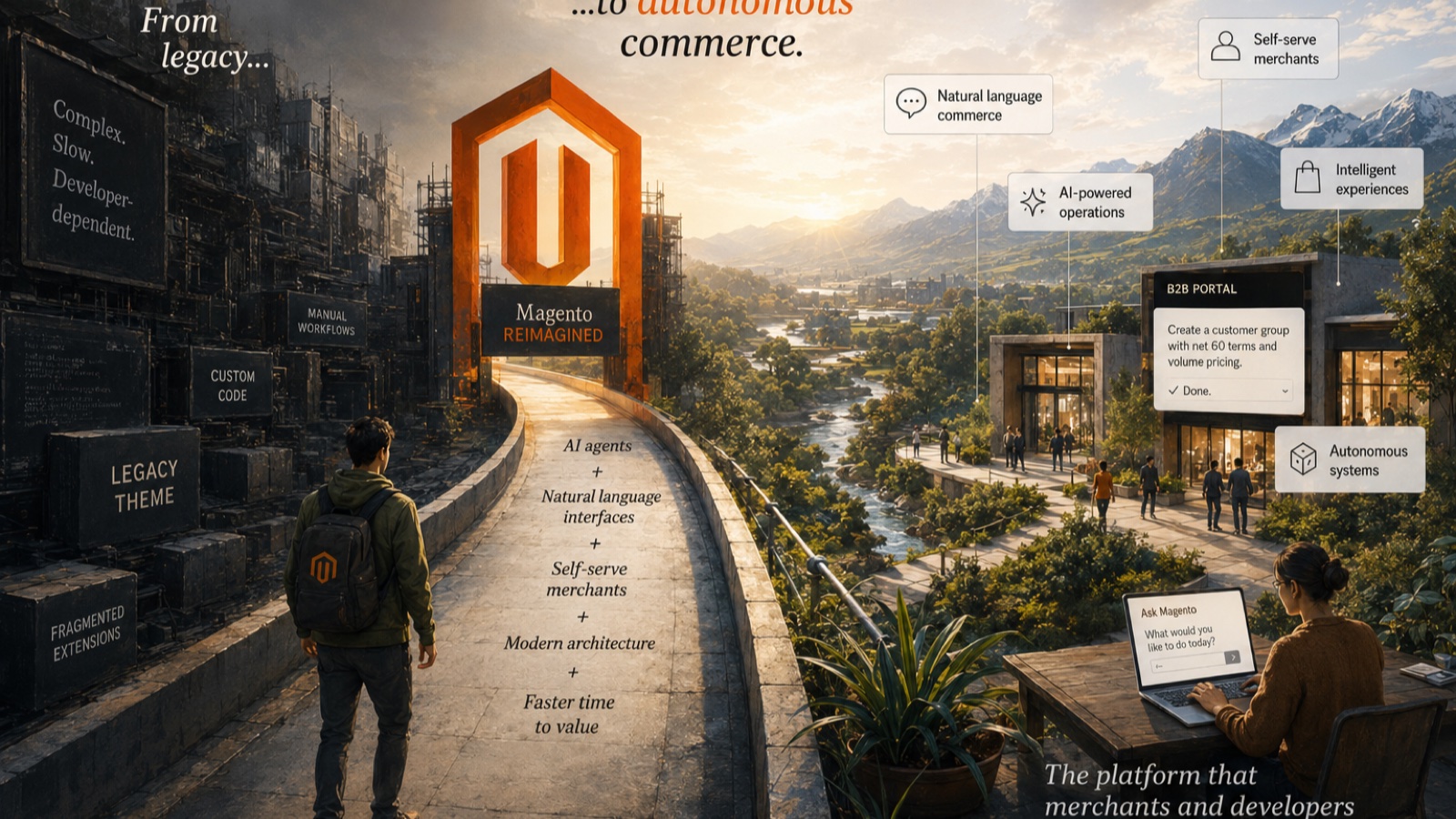
I’ve been pair-programming with Claude Code on real Magento stores for two years now. That’s a short window, but long enough to see the bigger shifts coming, not just “the code ships faster,” but the kind of people who write that code is changing, the pricing model Adobe charges is under pressure, and a small store owner who runs their site without a developer is suddenly a real thing. This is a forecast of those shifts. Real opinions, named tools, real numbers, and the strongest argument against me for each one. I’m an Adobe-Certified Magento and Hyvä developer, this isn’t a consulting-firm slide deck.
The 10 predictions in 90 seconds
Where Magento is today (2026)
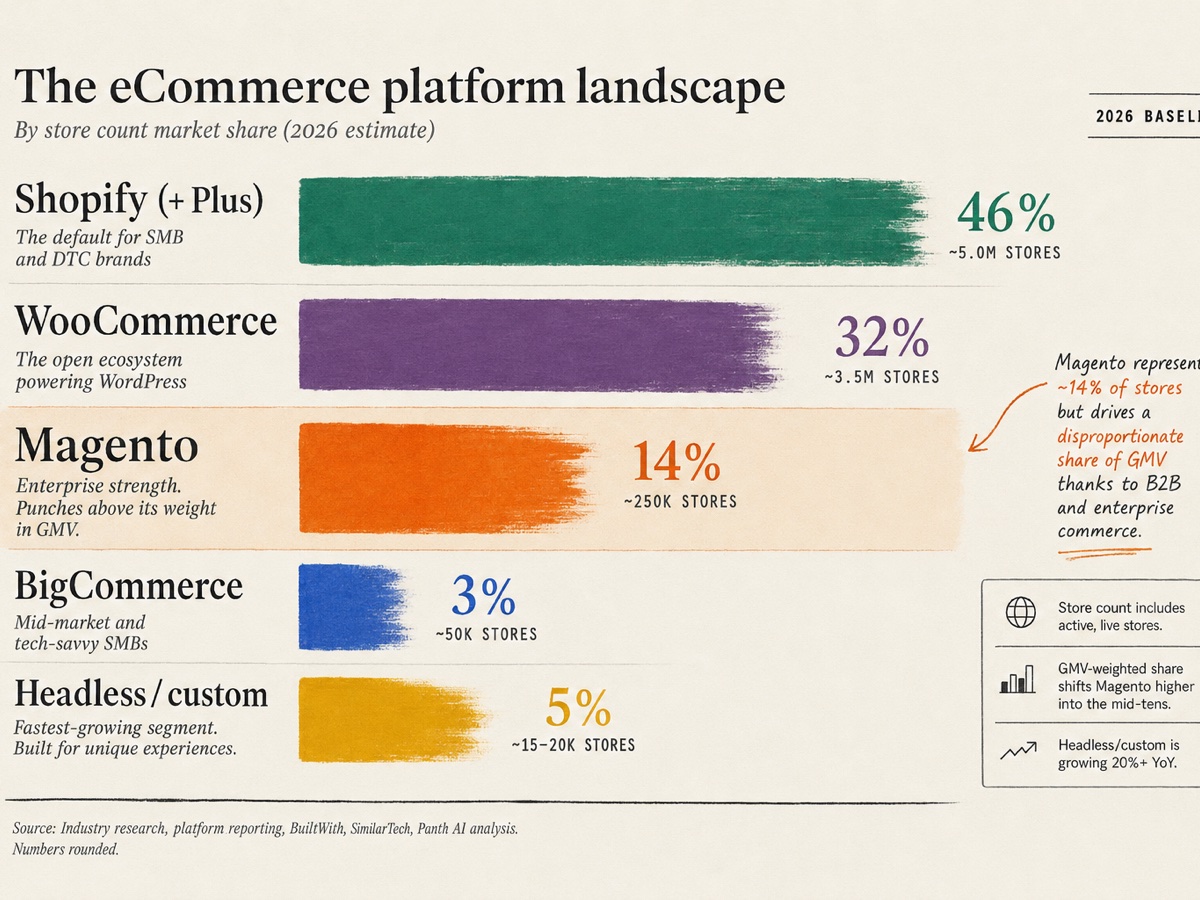
Before guessing where this goes, let’s be honest about where Magento sits today, not in the Adobe Investor Day deck, but in the real install base.
The AI inflection point
Three years separates ChatGPT 3.5 from Opus 4.7. In coding terms, that’s the gap between “fun toy” and “the most productive engineer on the team.” Here’s how we got here:
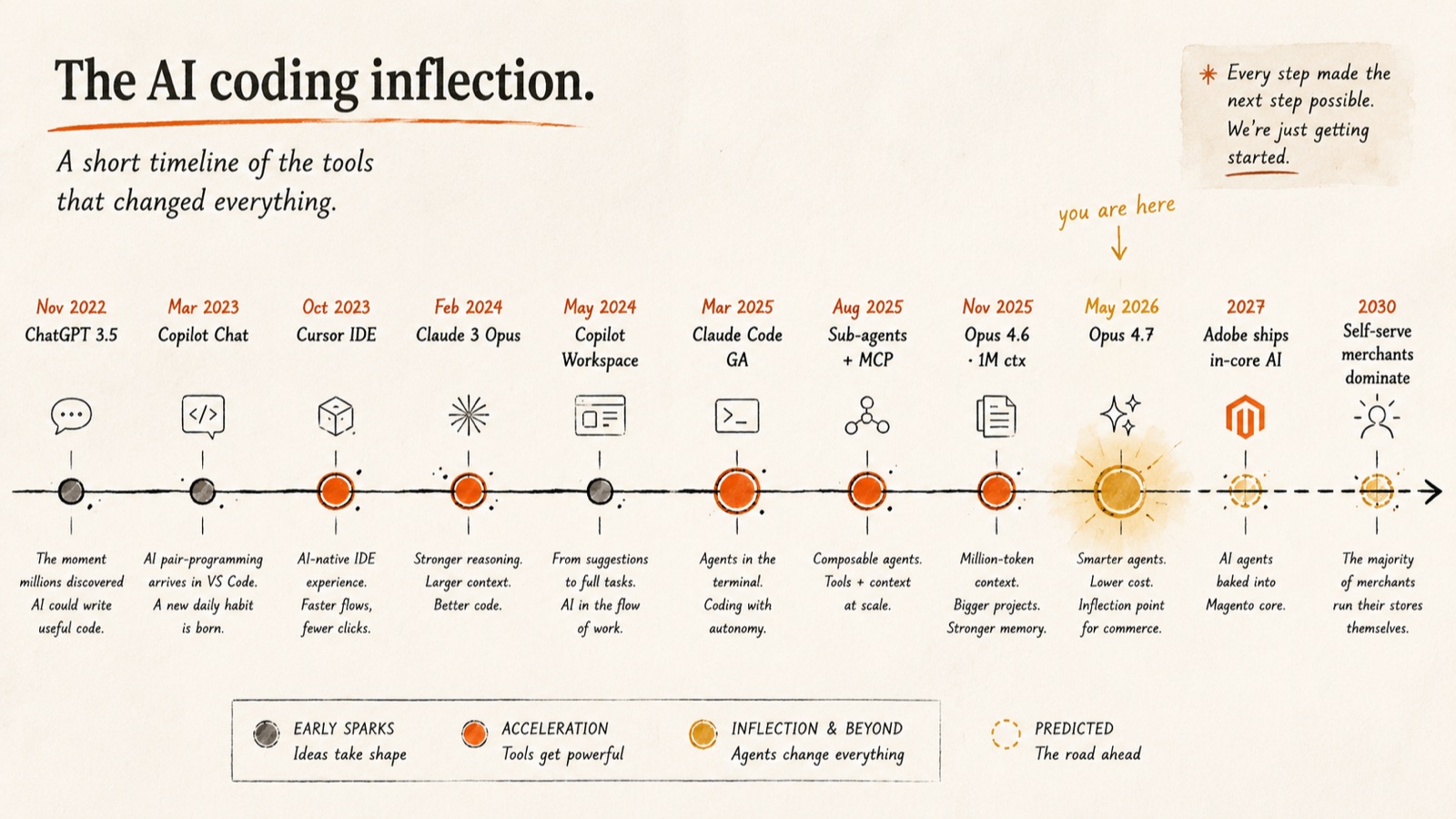
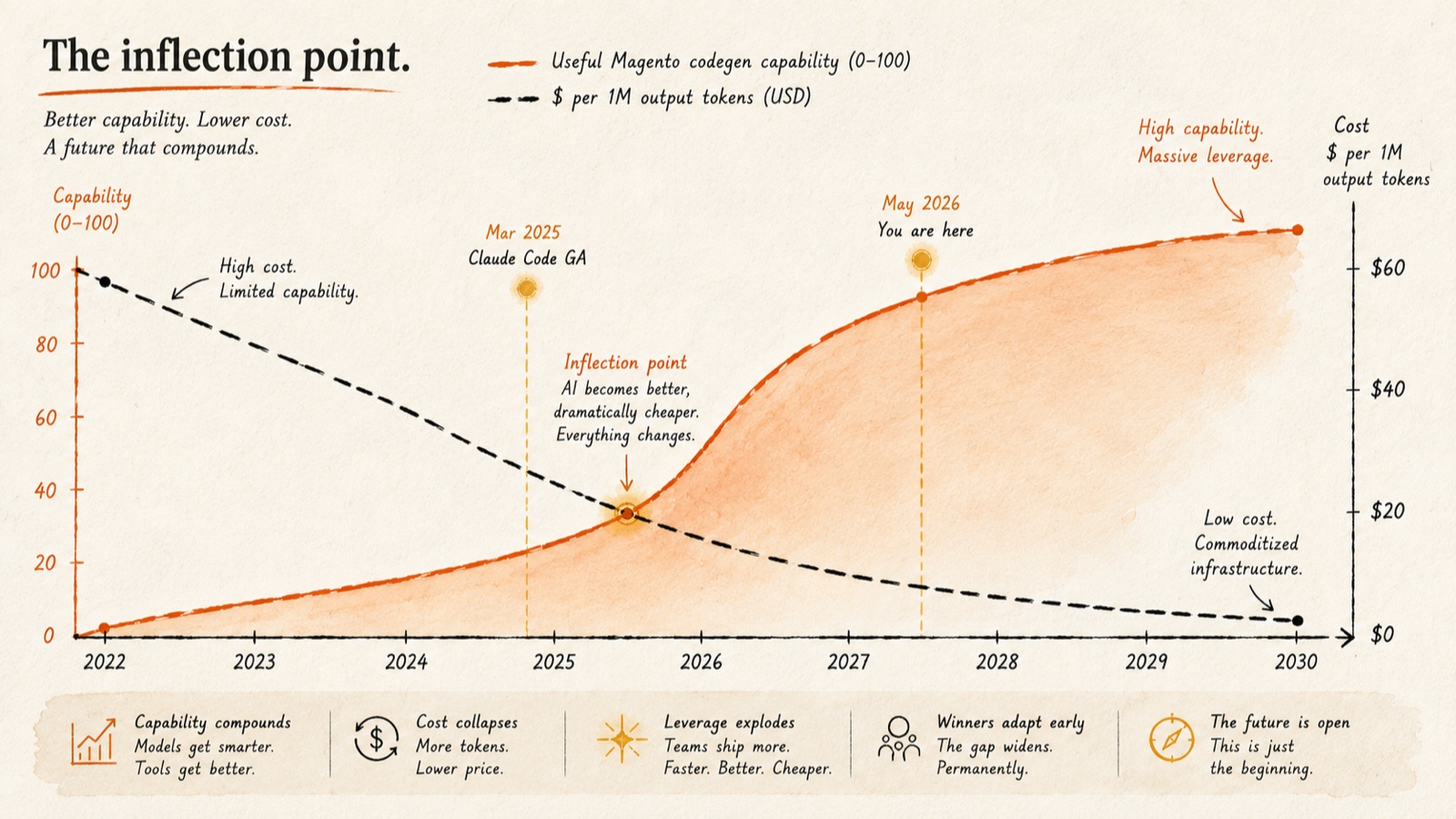
The point isn’t any single model release. It’s the slope , ability going up, price going down, both compounding fast. The crossover for “actually useful Magento code generation” hit in March 2025 with Claude Code GA. Everything before then was a fun experiment. Everything after has been real work.
The platforms, ranked by AI-readiness
Before I predict Magento’s next moves, let’s map where each big platform stands going into the AI era. Five categories cover the field: Magento + Adobe Commerce, Shopify (+ Plus), WordPress + WooCommerce, BigCommerce, and the fast-growing headless camp (Saleor, Medusa, CommerceTools, Next.js Commerce).
“The platform that wins the AI era won’t be the one with the smartest AI features. It’ll be the one whose codebase AI can write the best.”
Magento & Adobe Commerce
The enterprise-customisable PHP standard.
Today
~250k live stores. 70% open-source, 30% Adobe Commerce. Strong in B2B, multi-store, EU compliance, regulated industries. Lost the SMB segment to Shopify decisively.
AI strategy
Reactive. Adobe Sensei does product recommendations + Live Search. No first-party AI dev tooling yet. The AI advantage on Magento is community-driven (Claude Code + Hyvä + custom MCP servers), not Adobe-driven.
Strength
Open codebase, AI agents can read 100% of the source, plugins, and themes. PHP + Composer is a mature, predictable target. Hyvä theme stack is Tailwind + Alpine, which AI writes natively well.
Weakness
Adobe Commerce license cost + cloud lock-in. PWA Studio is a dead-end. EAV catalog model is hard for AI to reason about. Documentation lags 1-2 versions behind reality.
Shopify (+ Plus)
The SMB and DTC e-commerce default.
Today
~5M+ stores. Owns SMB & DTC. Plus competes mid-market. ShopifyQL + Liquid + Hydrogen ecosystem is the most coherent of any platform.
AI strategy
Aggressive, first-party. Shopify Magic (Sidekick + product-copy AI + media editing) shipped in 2023. Hydrogen + Oxygen optimized for AI codegen. Theme editor integrates AI by default. Sidekick (merchant-facing agent) is the most advanced agent of any platform.
Strength
Vertical integration, storefront, fulfillment, payments, marketing, analytics, and now AI agents all live inside Shopify. No hosting headache. ShopifyQL + GraphQL Admin API give AI agents a clean schema.
Weakness
Liquid is constrained, AI can’t generate arbitrarily-complex Liquid. Hard limits on customization. Per-transaction fees compound at scale. B2B still nascent vs Magento native B2B Companies.
WordPress + WooCommerce
Content-first commerce. Blog + store hybrid.
Today
~3.5M Woo stores. Dominant in content-led commerce (publishers, courses, services). Owned by Automattic. WordPress 6.x AI assistants exist but are bolt-on.
AI strategy
Plugin-led. Automattic ships Jetpack AI for content; WP-AI plugins from third parties for code generation. No first-party developer-facing AI tooling. WordPress plugin ecosystem is messy for AI to reason about (40k+ plugins).
Strength
Massive WP + Woo dev pool. Content + commerce hybrid wins for publishers + creators. Open codebase. Cheap to start (free + cheap hosting).
Weakness
Plugin sprawl, AI agents trip on conflicting plugins. PHP + jQuery legacy. Woo’s data model (custom post types) is weird for AI. Hard to scale past ~10k SKUs without serious customization.
BigCommerce
Open SaaS, the Shopify alternative with fewer fees.
Today
~50k stores. Better B2B than Shopify, worse than Magento. Open APIs are first-class. Used heavily by tech-savvy SMB + mid-market with no per-tx fees.
AI strategy
Quiet, API-led. Less marketing, more developer documentation for AI integration. Stencil theme system is constrained but AI-friendly. BC has the best public GraphQL API of any major platform.
Strength
No transaction fees. Stencil is simple enough for AI codegen. Open APIs make headless + AI integrations easy. Better B2B than Shopify at every plan tier.
Weakness
Brand awareness is the lowest of the top-5. Stencil customization ceiling is lower than Liquid (which is lower than Magento PHP). Limited app marketplace vs Shopify.
Headless & custom stacks
Build your own. Saleor, Medusa, CommerceTools, Vendure, Next.js Commerce.
Today
Saleor (Polish open-source). Medusa (Node + TypeScript). CommerceTools (enterprise MACH-cert). Vendure (TS + GraphQL). Next.js Commerce (Vercel). Combined ~10-20k stores but growing fast.
AI strategy
AI-native by design. TypeScript + GraphQL + Node makes these the easiest stack for AI to write end-to-end. No vendor AI strategy needed, the developer + Claude Code IS the AI strategy.
Strength
Modern stack (TS / Node / GraphQL / React). AI writes this best of any commerce option. No vendor lock-in. Best for digital-first DTC + B2B that need bespoke flows.
Weakness
You build the admin, the marketing tools, the fulfillment integrations, everything. AI helps a lot, but you still own all of it. No off-the-shelf templates for retail-specific flows (return-management, gift cards, loyalty).
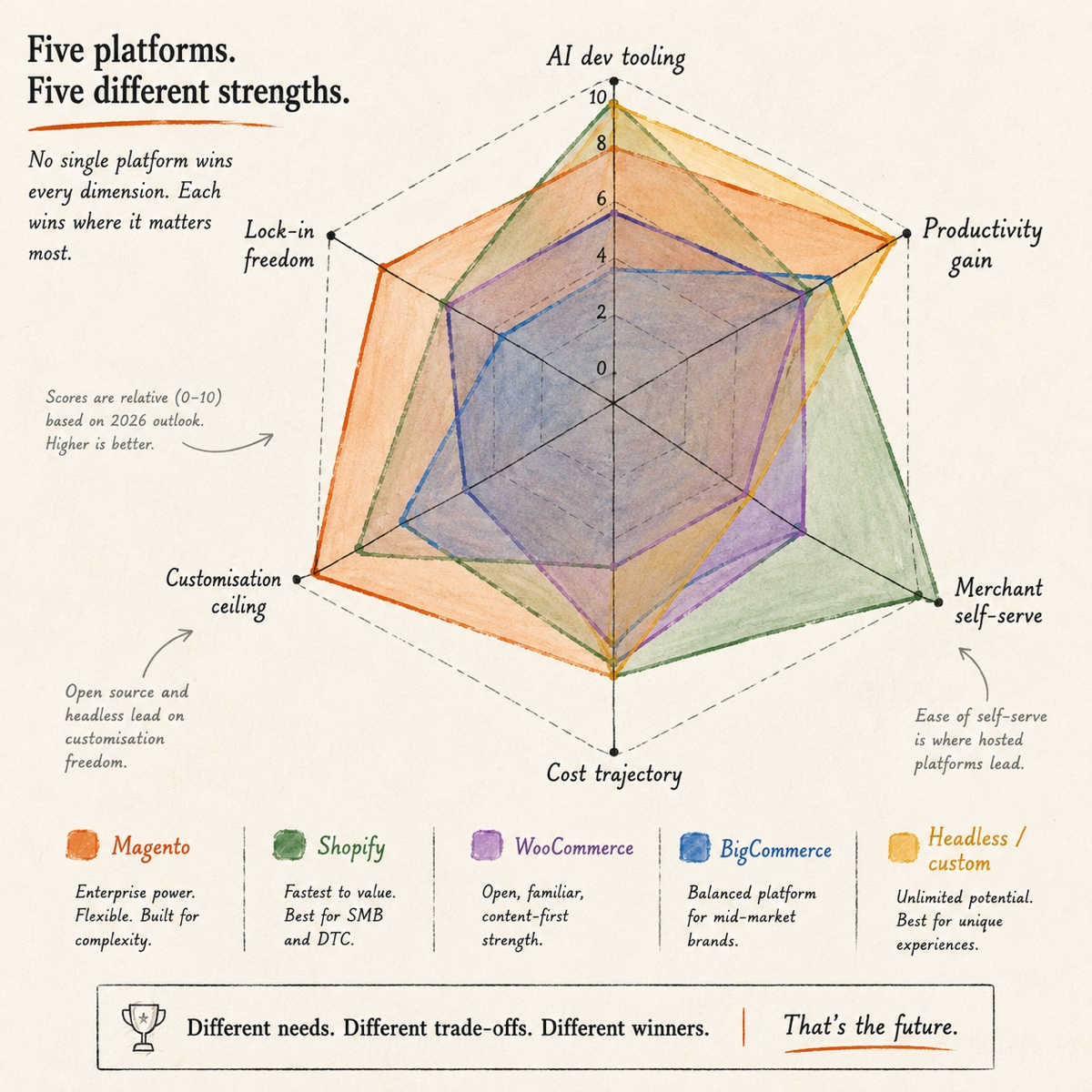
5 platforms × 6 dimensions, the numbers
Scoring 1-10 across six dimensions: AI dev tooling, productivity gain, merchant self-serve potential, cost trajectory, customization ceiling, and lock-in freedom. Higher is better on every axis.
Adjust to your priorities, the ranking updates live
Drag any dimension’s weight up to 0× (ignore) or up to 3× (priority). The ranked list on the right recalculates as you change values.
Your ranking
Scores reflect my opinion from production builds, not a meta-analysis. Use the result to argue with me, not to make final platform decisions.
- Lower is better for "Lock-in risk", the score reflects ease of leaving the platform, not difficulty.
- Scores are my opinion based on production builds in 2025-2026, not market research data.
- Headless wins the AI-dev-tooling axis but loses on merchant self-serve, the tradeoff is fundamental.
10 things I think happen to Magento by 2030
Each prediction follows the same shape: what I think will happen, why I think it, and the strongest argument against me. Read the counterpoint last, that’s the part that’ll change your mind, not the prediction itself.
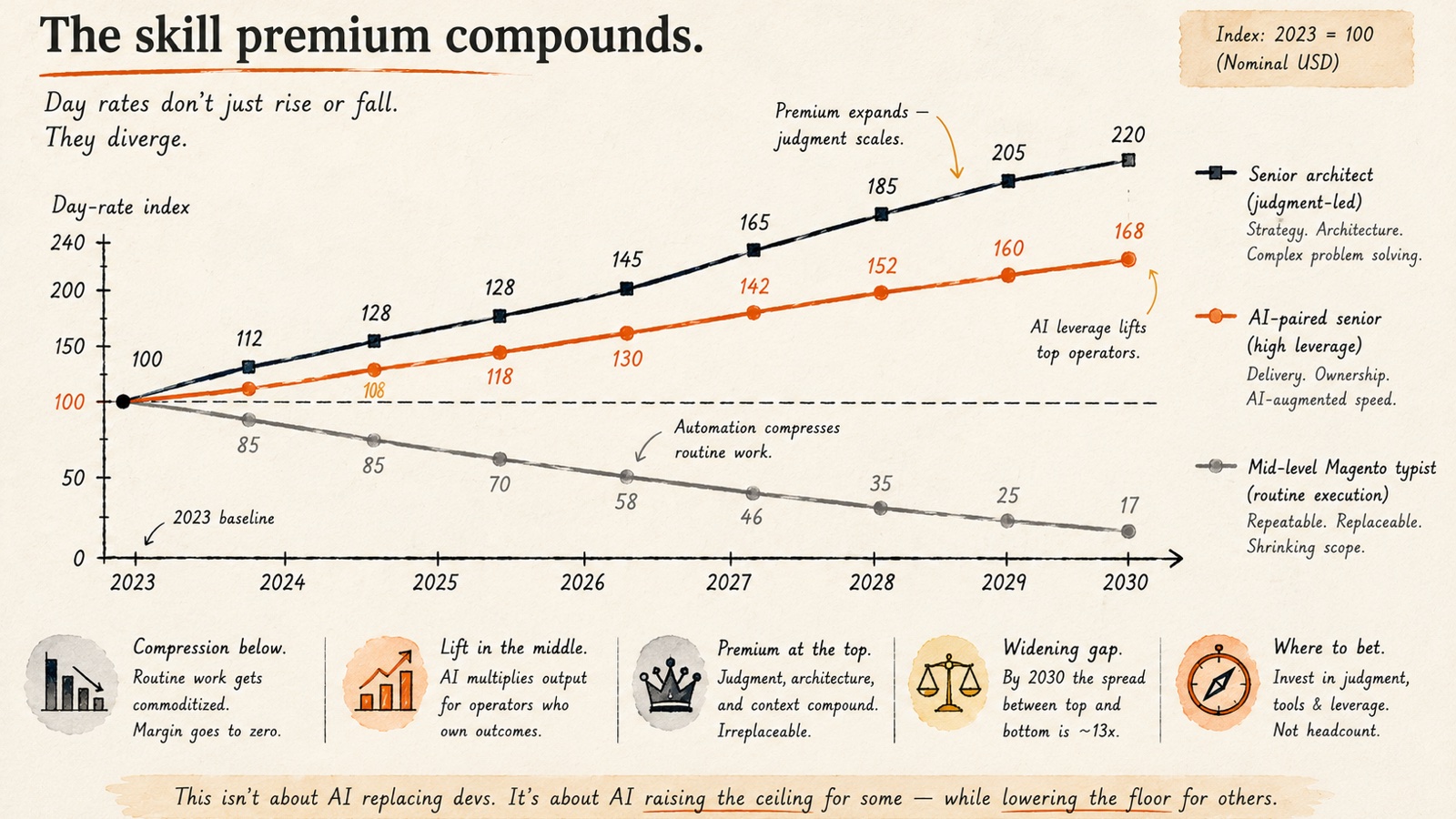
Magento dev day-rates compress 60-80% by 2028
The freelance Magento developer who charged $100/hr in 2023 is shipping the same output in 25% of the time by 2026. Either rates fall, or scope expands. Both happen.
AI-pair-programming on Magento has matured fast. A senior Magento dev with Claude Code can now ship a custom module, MFTF tests, db_schema migration, and DI configuration in the time it used to take just to write the controller. The economic floor for “a Magento module” collapses from $2-5k to $500-1.5k for the common cases. Top architects who can read a 50-module install and decide what to change still command $200+/hr, that part doesn’t compress. The middle layer (mid-level Magento devs at $40-80/hr) gets squeezed hardest.
“The middle of the Magento dev market is hollowing out. Either you’re a thinker or you’re a typist, and typists are getting outpaced.”
Senior architects, security specialists, and people who can debug a broken Adobe Commerce Cloud deploy at 3am still get paid. The compression hits production typing speed, not strategic judgment. Agencies who package the savings as “same scope, lower price” lose; agencies who package it as “3x scope, same price” win.
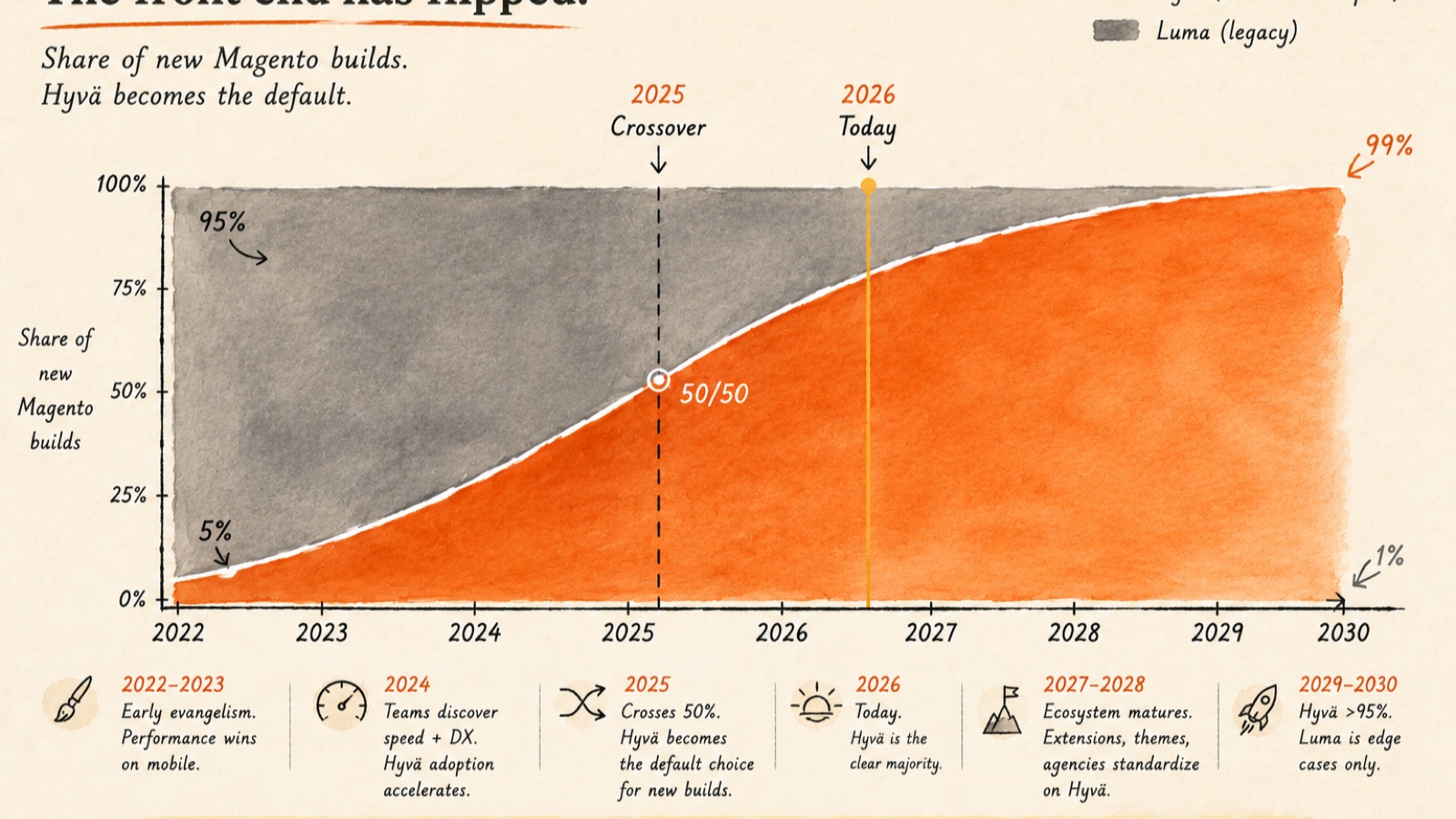
Hyvä becomes the default theme stack; Luma sunsets by 2027
Tailwind + Alpine is the frontend stack that AI writes best. Luma’s jQuery + Knockout + RequireJS combo confuses AI agents and produces brittle code. The community has already voted with their builds.
Adobe officially declared Luma frozen in 2022 (no new features, security patches only). Hyvä Themes has become the de-facto standard for new Magento builds since 2024. AI’s preference accelerates this, Claude Code generates clean Tailwind 4-5x faster than Luma-style Knockout view models, with fewer hallucinated APIs. By 2027, “new Magento build = Hyvä build” will be the assumption. Adobe doesn’t kill Luma; the market does.
“Luma will be alive in production for another decade. But no greenfield Magento build chooses Luma in 2027.”
Legacy Luma stores running healthy revenue won’t migrate, the ROI doesn’t pencil. A long tail of Luma stays in production through 2030 and beyond. But the new-store decision is over.
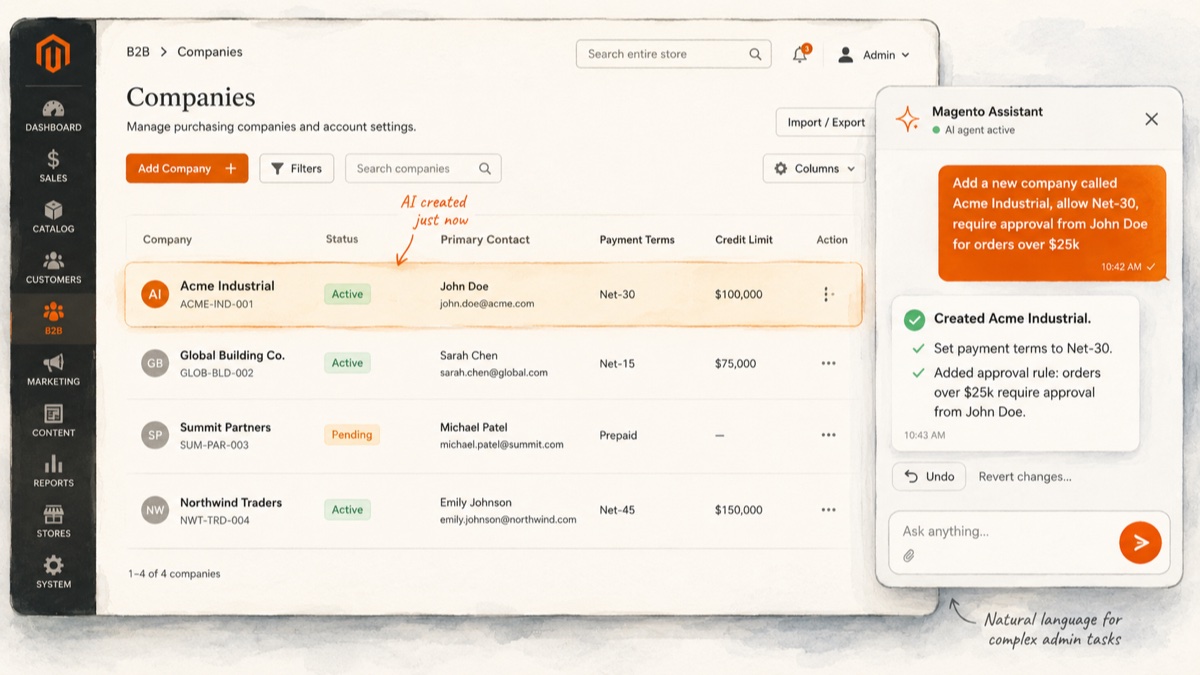
B2B catalog management moves to natural-language input
“Add a new company called Acme, give them the wholesale price list, allow Net-30, require approval from John for orders over $25k.” The Magento B2B admin agent does this in 12 seconds. The human B2B admin took 25 minutes.
Adobe Commerce’s Companies + Quotes + Shared Catalog workflow is powerful but baroque. Every config screen, every role permission, every tier-price, all of it is describable in natural language to an AI agent with admin write access. The unlock isn’t in the catalog data; it’s in the admin UX. By 2027, the “Magento admin” for routine B2B ops will be a chat interface, not a grid.
“In 2030, the question isn’t “how do I configure Magento B2B?”, it’s “tell my Magento store what I want it to do.””
The actual data integrity work, tax rules, customs, ERP sync, invoice templates, still requires deterministic configuration. AI agents are great at the chat-driven part; they don’t replace the ERP integration engineer.
Adobe Commerce pricing shifts from license-fee to usage-based by 2027
When AI compresses the developer’s value-add, Adobe’s $30k+/yr license stops looking like a no-brainer. Adobe has to pivot to GMV-based or AI-credit-based pricing to keep retention.
Adobe Commerce’s pricing today is a fixed annual license that scales with GMV bands. That model assumes: (a) the customer can’t easily re-platform; (b) the license includes valuable stuff humans struggle with. AI breaks both assumptions. Re-platforming gets cheaper (AI helps migrate); the stuff Adobe gives you (B2B Companies, content staging, segmentation) gets less hard to build from scratch. Adobe’s strategic choice: lower the license-fee floor (to capture price-sensitive escapees), or shift to AI-credits + GMV-tax (to monetise usage). The smart play is the latter.
“Adobe’s $40k/yr license made sense when typing the code was hard. Now typing is cheap. The price floor has to come down or the value-add has to come up.”
Adobe might double down on bundling Magento with Experience Cloud (Analytics, Target, Campaign, AEM). That gets “sticky” via the integration story, not the platform-features story. Plausible, but it shrinks Magento’s addressable market to enterprise-only.
MFTF testing flips, AI writes the tests, devs review them
In 2024, the typical Magento PR had 1 unit test for every 10 lines of code. In 2026, AI-paired devs ship 5-8 tests per 10 lines of code, because writing the test takes the AI 30 seconds.
Magento Functional Testing Framework (MFTF) is XML-declarative, perfect for AI codegen. Selenium under the hood means the tests are slow to run but easy to write. AI generates exhaustive edge-case coverage (empty cart, taxed cart, multi-currency, B2B-restricted product) that humans would skip because it’s tedious. The dev’s job shifts from “write the test” to “curate which AI-generated tests are worth keeping.” Test suites grow 5-10x. CI times grow 2-3x. CI infrastructure becomes a real engineering line item.

“Magento test coverage is about to explode. The bottleneck stops being typing speed; it starts being CI cost and review attention.”
AI generates plausible tests, not always correct ones. A test that runs and passes can still be testing the wrong thing. Human review remains essential, especially for security, payments, and compliance. The skill that scales is “reading 50 tests in 5 minutes and spotting the 3 that miss the point.”
AI-paired boutique agencies replace 25-person offshore Magento shops
A 5-person AI-paired Magento team in any timezone ships the output of a 25-person 2020-era offshore agency. Communication overhead becomes the limiting factor, and small teams win.
The 2015-2024 offshore Magento agency model worked because typing-speed was the constraint, 20 hands type more than 5. AI removes that constraint. The new constraint is “how fast can a human understand the codebase and make the right call?” That’s a senior-engineer skill, not a junior-engineer skill. 5 seniors with AI > 25 juniors with AI > 25 juniors without AI. The boutique agency, Adobe-Certified, senior-only, AI-paired, becomes a real economic threat to the legacy offshore behemoths. Especially when you remove the 5-day async communication tax.
“In 2027, hiring a 25-person offshore Magento team will look like hiring a 25-person typing pool in 1997. There’s a thing the tool does now.”
Big agencies have account management, project management, certification programs, insurance, trust infrastructure that small teams don’t. For enterprise clients with procurement processes, that still wins. The boutique threat is real but doesn’t kill the big shops, it just compresses their margins.
Composer dependencies become self-managing
The Magento 2.4.7 -> 2.4.9 upgrade in 2026 still takes 8-12 weeks. By 2028, an AI agent reads CHANGELOGs, tests upgrade paths, writes patches, and ships the upgrade in a long weekend.
Magento upgrades are painful because: (a) 3rd-party extensions break in opaque ways; (b) Adobe’s changelog hides breaking changes in dependency bumps; (c) testing is manual. AI flips all three. An agent can: read the diff between 2.4.8 and 2.4.9, identify every breaking signature in your installed modules, write composer patches for the ones that need it, run MFTF against the upgraded build, and ship a PR with the rollback plan in the description. The 8-12 week upgrade cycle goes to 1-2 weeks. By 2028, Adobe might even ship Magento with a built-in upgrade agent, if they don’t, a 3rd party will.
“In 2030, “we’re still on 2.4.7 because the upgrade is too painful” will be a 2024 sentence.”
Coordinating 3rd-party vendors who haven’t tested their module against the new version is still a human problem. Some patches need vendor sign-off for warranty reasons. The agent doesn’t fix that; it just shortens the engineering loop around it.
80% of merchants under $5M GMV self-serve their Magento store by 2030
Small merchants today need a developer for every theme tweak, every new payment method, every shipping rule. By 2030, an admin-side AI agent handles 80% of that work. The remaining 20% becomes the dev’s whole job.
Most <$5M GMV Magento merchants run vanilla Hyvä with 3-5 paid extensions. Their developer hours are 80% “change the homepage banner” and 20% “integrate the new shipping provider.” The 80% gets automated by admin-side AI agents (Magic-like for Magento). The 20% remains genuinely hard. Devs who serve this segment lose 80% of their hours; the segment loses 60% of its dev spend; everyone shifts up-market. Adobe + Hyvä both ship admin AI agents to capture this, or a 3rd party (probably AI-first) eats the segment.

“The Magento dev for a $2M-GMV store today is full-time. In 2030, they’re a 2-hour-per-month insurance policy.”
Self-serve only works if the AI is reliable. The merchant who breaks their checkout via an AI-applied config change at 3am needs a human. Magento agencies pivot to “the safety-net” rather than “the typist”, on-call retainer instead of project-based.
PWA Studio quietly dies; React Server Components + Hyvä replace it
Adobe PWA Studio launched in 2018 with high ambition and modest adoption. AI doesn’t save it. By 2027, it’s officially deprecated, and Hyvä + RSC fills the headless gap.
PWA Studio is 8x more expensive than Hyvä per build, with worse Lighthouse scores and a steeper learning curve. AI codegen exposes the architectural choice clearly: declarative Tailwind + Alpine (Hyvä) is faster to generate, easier to debug, and produces better-performing output than React + Apollo + GraphQL (PWA Studio). For the truly headless use cases (native apps, complex multi-channel), React Server Components + the Magento GraphQL API is the new pattern. PWA Studio stops getting investment and quietly sunsets.
“PWA Studio joins MTF (Magento Test Framework) and Magento 1 in the “technologies Adobe quietly walked away from” pile.”
Adobe might pivot PWA Studio to be AI-native (e.g., agent-driven page generation). Plausible but unlikely, the architectural debt is too deep. More likely Adobe just stops talking about it.
Magento ships AI agents in-core by 2028
Shopify shipped Sidekick. Stripe shipped AI for payments. WooCommerce ships Jetpack AI. Adobe Commerce ships, nothing, yet. They have to ship by 2028, or they cede the merchant-facing AI surface to 3rd parties forever.
Adobe has the assets to build a competitive Magento AI agent: Adobe Sensei (existing ML), Adobe Experience Cloud (omnichannel data), Adobe Commerce Cloud (operational hooks). What they don’t have is the will to disrupt their own license-fee model with self-serve admin. The internal Adobe argument will be brutal. They either ship a Magento-native AI agent (probably called “Commerce Sensei” or similar), or a 3rd party builds it on top of the Magento API and captures the user attention. By 2030, every Magento admin has at least one AI agent, the only question is whether Adobe or someone else owns the chrome.
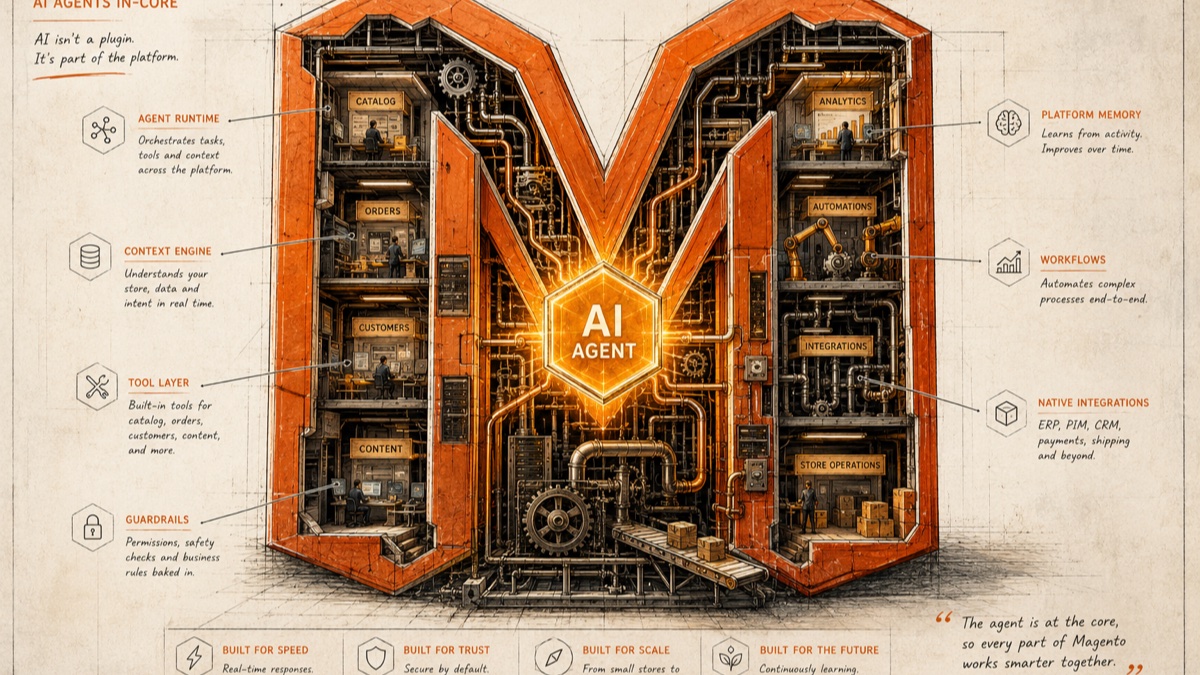
“In 2030, Magento has an AI agent in core. The interesting question is whether Adobe or Anthropic ships it.”
Adobe might ship via the Adobe Experience Cloud route, an AI agent that sits across AEM + Analytics + Target + Commerce, not inside Magento itself. That preserves the license-fee model but cedes the Magento-specific use case to 3rd parties.
The new Magento dev workflow
Same 8-step development cycle. Very different time budget for each step. Here’s what AI-paired Magento work actually looks like in 2026.
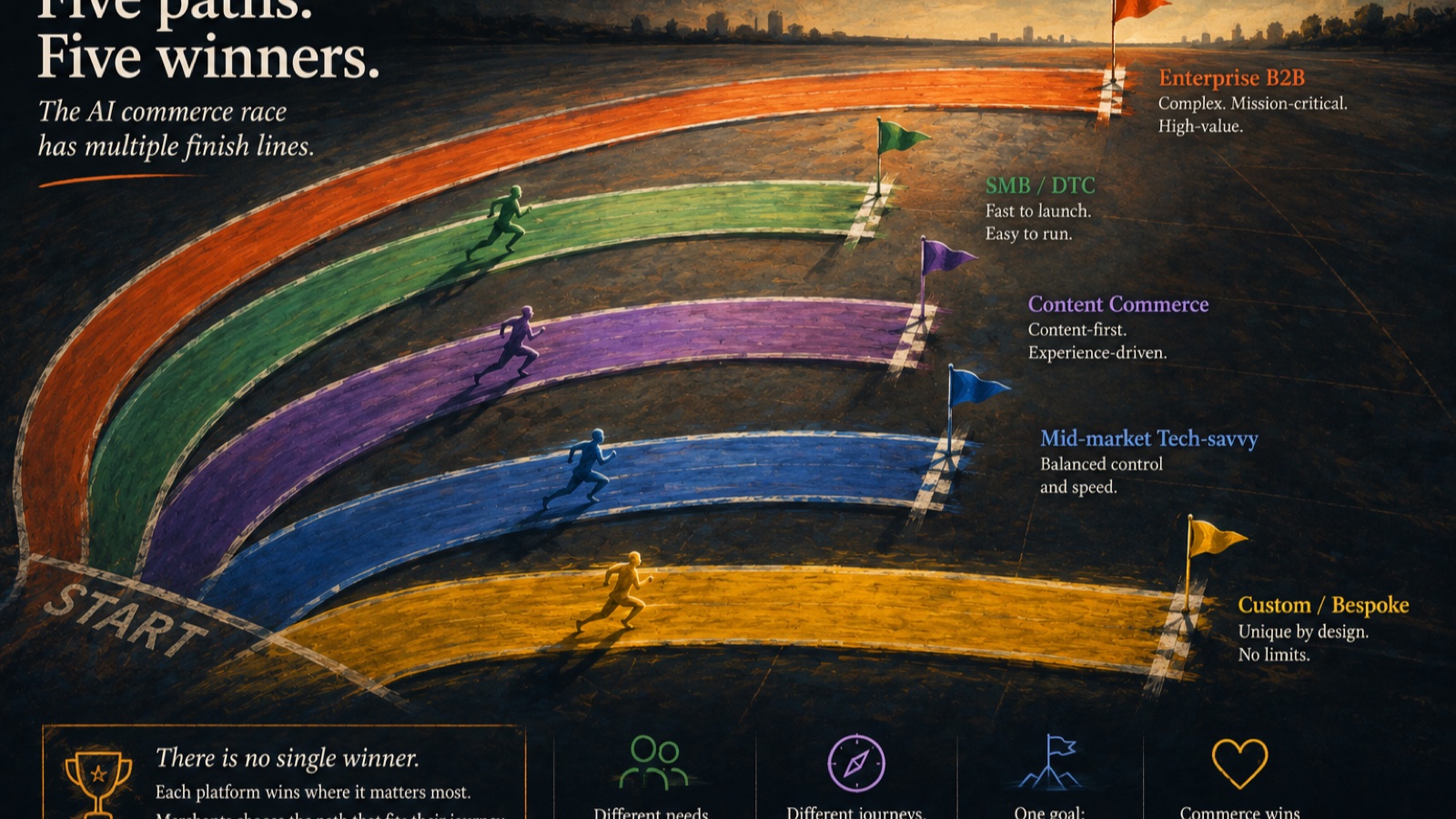
So who actually wins the AI e-commerce race?
“No single platform wins the whole race. Five different platforms each win a different slice of the market, and by 2030, what platform you run matters less than what AI tools you bring to it.”
The honest answer is split by segment. Different stores need different things. Here’s who I think takes each slice by 2030:
SMB & DTC < $5M GMV
Sidekick + Liquid + ecosystem coherence. The merchant doesn’t need a developer. Shopify already won this segment; AI cements it.
Runner-up: WooCommerce holds the content-led slice; BigCommerce gets the tech-savvy slice.
Mid-market $5-50M GMV
Brand-led DTC → Shopify Plus. B2B-heavy → Magento Open Source. Tech-first DTC → Saleor / Medusa. Content-led → Woo. AI lowers the cost of bespoke, so headless options gain share.
Runner-up: Adobe Commerce loses share in this band if they don’t shift pricing.
Enterprise B2B + regulated industries
B2B Companies + multi-store + EU compliance + audit trail story. Shopify Plus B2B is closing but still 2-3 years behind. AI tools work fine on Magento, the moat is product, not codegen-friendliness.
Runner-up: CommerceTools at the very top end for MACH-cert enterprises.
Tech-first & bespoke
AI writes TypeScript + GraphQL + React faster than any other stack. No platform lock-in. The merchant + 2-3 senior engineers + Claude Code ship things that would have required a 15-person agency in 2022.
Runner-up: Adobe Commerce Cloud for the very large enterprises that need the support contract.
Content + commerce hybrid
Creators, course-sellers, publishers, services. The content-management moat doesn’t collapse with AI, if anything it expands because content workflows benefit from AI assistance.
Runner-up: Shopify with Hydrogen + content as a secondary capability.
What this means if you sell things
< $1M GMV
Don’t hire a Magento dev. Use Shopify with Sidekick, or self-serve Hyvä via a single retainer dev. Magento Open Source + Hyvä + Claude Code + a 1-day-a-month retainer is the most cost-efficient setup that still gives you full ownership.
$1-10M GMV
Hire an AI-paired boutique (3-5 people, all senior, Adobe-Certified). Run Hyvä, not Luma. Move B2B to Magento Open Source instead of Shopify Plus if you have > 20% B2B revenue. Plan one major release per quarter, not per month.
$10M+ GMV
Adobe Commerce Cloud still makes sense for compliance + SLA. Push Adobe for usage-based pricing; the license-fee floor is becoming uncompetitive. Invest in an internal MFTF + CI pipeline. Hire 1 senior platform engineer + an AI-paired agency on retainer.
What this means if you write code
Senior & architect
You win the next 5 years. Your skill (read a codebase, decide what to do, judge AI output) compounds. Invest in: domain breadth (B2B / multi-store / regulated), Hyvä, Claude Code mastery, MCP servers. Raise rates, the buyers are getting more, not less.
Mid-level
The squeeze is real. The escape is up, learn architecture, security, ERP integration, performance. Don’t compete on typing speed (AI wins); compete on judgment. Specialise in a niche (B2B, performance, Hyvä) that needs human depth.
Junior & learning
Hardest path. Routine work is automated; the apprentice ladder is being kicked away. Realistic moves: pair with AI as your tutor (not your colleague), build public work that demonstrates judgment (not output), specialize early in a regulated niche where humans still own the trust.
3 things Adobe should do this quarter
Pricing model
Shift to usage-based + AI-credits within 18 months. Open Source stays free; Adobe Commerce becomes a metered upgrade with predictable per-GMV pricing. Drop the $30k floor; that money is leaving anyway.
AI strategy
Ship a Magento-native AI admin agent by 2027. Don’t let a 3rd party own the merchant chrome on top of your platform. Integrate Adobe Sensei deeply into the admin (search, content, segment) and make it the default.
Developer experience
Sunset PWA Studio. Adopt Hyvä into the official theme stack. Make MFTF AI-friendly (better docs, simpler XML). Open-source more of the Commerce-only modules (B2B, content staging) to slow the headless bleed.
Risks and open questions
Every prediction can be wrong. Here are the things that could make big chunks of this forecast look silly in two years.
-
01
Hallucinated code in production
AI writes plausible-looking code that doesn’t do what it claims. MFTF + CI catches most of it; review attention catches the rest. The risk doesn’t kill the productivity gains but it does require new review skills, and review-skill quality varies wildly across teams.
-
02
Junior career ladder gets kicked away
The work that taught juniors how Magento worked is now automated. Where do the next-decade architects come from if no one writes a controller by hand anymore? This is the real concerning question, not a Magento-specific risk, but an industry one.
-
03
Vendor lock-in to specific AI tools
CLAUDE.md, .cursorrules, GitHub Copilot config, these are mini-platforms. If your codebase is shaped to be readable by one AI vendor and they raise prices or get acquired badly, you have a migration cost. Open standards (MCP from Anthropic helps) reduce this but don’t eliminate it.
-
04
AI accessing the production codebase
Most AI dev tools need to read your repo, sometimes your DB schema, sometimes your prod credentials. The security threat model is new and the industry hasn’t caught up. Expect a major AI-related security incident on a major Magento store in the next 18 months.
-
05
Magento Marketplace + EQP keeping pace
When AI lets one dev ship modules 10x faster, the EQP + Marketplace review process becomes the bottleneck. Modules pile up in review. Vendors who self-publish on GitHub instead of Marketplace win. Adobe has to invest in faster EQP cycles or lose the Marketplace as a quality moat.
-
06
Adobe’s strategic confidence
Adobe has been quiet on Magento AI strategy for 24 months. That’s an Adobe-strategy problem, not a Magento-product problem. Internal alignment between AEM, Analytics, Target, and Commerce on AI is the constraint, if Adobe gets it right, Magento wins the enterprise. If Adobe fumbles, Magento bleeds.
Common counter-questions
Will Magento survive the AI era?
Yes, in the segments where it’s strongest. Magento (Open Source + Adobe Commerce) will dominate enterprise B2B, multi-store, regulated industries, and EU-compliance-heavy commerce through 2030 and beyond. Where it bleeds is the SMB / DTC segment under $5M GMV, which Shopify already won and now cements with Sidekick + Hydrogen. Magento survives, but its addressable market shrinks: from “everyone” to “serious B2B + custom-heavy enterprise.” That’s still a multi-billion-dollar segment globally. The platform isn’t going anywhere; the merchants who choose it just look more specific.
Should I still hire a Magento developer in 2027?
Yes, but a different kind. The mid-level “types code from tickets” Magento dev is being squeezed out by AI productivity. The senior architect, B2B specialist, performance engineer, and Hyvä expert are getting more valuable, not less. Hire for judgment, can this person read your codebase, decide what to do, and curate AI output, not for typing speed. Day-rates for senior Adobe-Certified Magento + Hyvä engineers will rise through 2030 even as mid-level rates compress. Look for AI-paired boutique agencies (3-5 senior engineers, all AI-paired) over 20-person offshore shops.
Is Adobe Commerce’s $30k+/yr license still worth it in the AI era?
Depends entirely on your B2B + compliance needs. If you’re a regulated industry (pharma, defense, multi-region B2B) at > $25M GMV, yes, the B2B Companies module, content staging, SLA, and Adobe Commerce Cloud’s Fastly + 24/7 support justify the license. If you’re a sub-$10M-GMV DTC store paying the license for product recommendations and Page Builder, no, you can do all of that on Magento Open Source + Hyvä + a good developer for a fraction. Expect Adobe to shift to usage-based pricing within 18-24 months as the license-only value erodes. If you’re on Adobe Commerce today, push for a usage-based deal at renewal.
Will Hyvä fully replace Luma?
For new builds: yes, effectively already happening. Hyvä (Tailwind + Alpine) is what AI codegen writes best, what produces Lighthouse 95+ out of the box, and what new agencies default to. By 2027, “new Magento build” will mean “Hyvä build” in 90%+ of cases. For existing Luma stores: not necessarily, the ROI doesn’t pencil for a healthy revenue Luma store to migrate just because Hyvä is faster. Luma stays in production through 2030 and beyond, but stops being the choice for greenfield work. Adobe doesn’t kill Luma; the market does, with AI codegen accelerating the trend.
Should I learn Magento as a junior developer in 2026?
Cautious yes, if you understand the path is harder than 2020. Routine Magento dev work is being automated by AI, which kicks away the apprentice ladder. To make junior → senior in 2026-2030, you need to: (a) treat AI as your tutor, not your colleague, learn the platform deeply, don’t just paste its output; (b) specialize early in a regulated or B2B niche where human judgment still owns the trust; (c) build public work that demonstrates judgment, not just shipped output. The pure “take a ticket, write the code” junior path is closing. The “become a Magento + Hyvä + AI domain expert” path is wide open, but it’s steeper.
Can AI fully replace a Magento agency?
Not in 2026, and not by 2030 for any non-trivial store. AI replaces typing, not strategy or accountability. A Magento agency in 2030 still: scopes the project, owns the architectural decisions, integrates with your ERP and warehouse, runs the QA cycle, handles edge cases, manages the deploy, takes the 3am call when checkout breaks during BFCM. AI compresses the labor-hours inside that work by 3-5x, but the work itself doesn’t go away. The shift is from “25-person offshore agency” to “5-person AI-paired boutique.” The agency model isn’t dying, it’s consolidating into smaller, senior-heavier teams.
Will the Magento Marketplace become irrelevant?
It’s under pressure. When AI lets one engineer ship a custom module in hours, the “buy a paid extension from Marketplace” decision starts losing to “build it custom in two days.” That’s already happening for simple needs (basic UI tweaks, simple integrations). The Marketplace stays relevant for: (a) complex integrations with named 3rd parties (Avalara, Klarna, Adyen) where the vendor maintains the bridge; (b) anything that needs ongoing vendor support and SLA; (c) the EQP badge as a trust signal. Adobe needs to: speed up EQP cycles, lower commission, and make AI-friendly module discovery a priority. If they don’t, vendors will publish directly on GitHub or Packagist and bypass the Marketplace.
What’s the most future-proof Magento skill to learn in 2026?
Three skills, in order of leverage: (1) Architecture & judgment, how to read a 50-module Magento codebase, decide what to refactor vs leave, and explain the trade-off. (2) Performance + observability, Lighthouse 95+, INP, Core Web Vitals, Fastly tuning, MFTF coverage strategy, the operational reality AI struggles to debug alone. (3) B2B + regulated domain depth, Adobe Commerce B2B, multi-store, multi-region tax, GDPR/CCPA/PDPL, pharma/finance compliance. AI writes code; humans still own domain trust. The skill NOT to invest in: hand-typing speed on routine features. AI eats that whole.
Will Shopify’s AI features kill Magento’s growth?
Shopify Sidekick + Magic kill Magento’s SMB growth, that boat sailed in 2023 and AI cements the loss. They do NOT kill Magento’s B2B and enterprise growth. Sidekick is a brilliant SMB-tooling product; it’s not designed for multi-store B2B with Net-30 quote workflows, shared catalogues, requisition lists, or company hierarchies. Shopify Plus B2B is closing the gap but still 2-3 years behind Magento’s native B2B Companies module. Magento’s growth corridor is in B2B, multi-region, regulated industries, and custom-heavy mid-market, segments where Shopify’s ergonomic-SMB-first design works against it.
What does Adobe need to do to keep Magento relevant?
Three things, urgently. (1) Pricing pivot: shift Adobe Commerce to usage-based + AI-credit pricing within 18 months. The $30k+ license floor is uncompetitive in the AI era when self-serve options exist. (2) Ship a Magento-native AI agent by 2027, admin-side + dev-side. If Adobe doesn’t own this surface, a 3rd party (probably AI-first) will sit on top of the Magento API and capture all merchant attention. (3) Adopt Hyvä into the official theme stack and sunset PWA Studio. Pretending PWA Studio is the future is costing Adobe credibility. The community has already chosen; Adobe needs to publicly catch up.
What I read to write this
- Adobe Commerce 2.4.9 release notes Adobe Experience League, May 2026
- Claude Code documentation docs.claude.com/claude-code, Anthropic
- Hyvä Themes, adoption data hyva.io/community-stats, 2026
- BuiltWith e-commerce platform stats trends.builtwith.com/shop, Q1 2026
- Shopify Sidekick announcement shopify.com/sidekick, July 2023
- Saleor & Medusa, commit velocity github.com/saleor + github.com/medusajs, 2026
- MACH Alliance composable commerce machalliance.org, Q1 2026
- Adobe Sensei AI for Commerce adobe.com/sensei, 2026
Disagree? Tell me why.
Forecasts are arguments, not facts. If you think one of the predictions above is dead wrong, especially the ones you have real-world experience with, leave a comment. Every comment is reviewed before it shows up here.
Pair with an Adobe-Certified Magento dev who lives this.
I’ve been AI-pair-programming on production Magento stores for two years. If you want to run the AI experiment on your codebase without the learning curve, book a 30-minute call, or grab a fixed-price audit.
Leave a comment
Your email stays private, it’s never shown publicly. Every comment is reviewed before it’s published.